


A few weeks ago I wrote about Parkinson's Law and AI - how we fill saved time with more work unless we actively protect it.
One reply stuck with me: "Leon, the problem isn't me. It's my company. I finished my work in 4 hours. My reward was more work."
And I sat with that. Because they're right. But they're also only seeing half the picture.
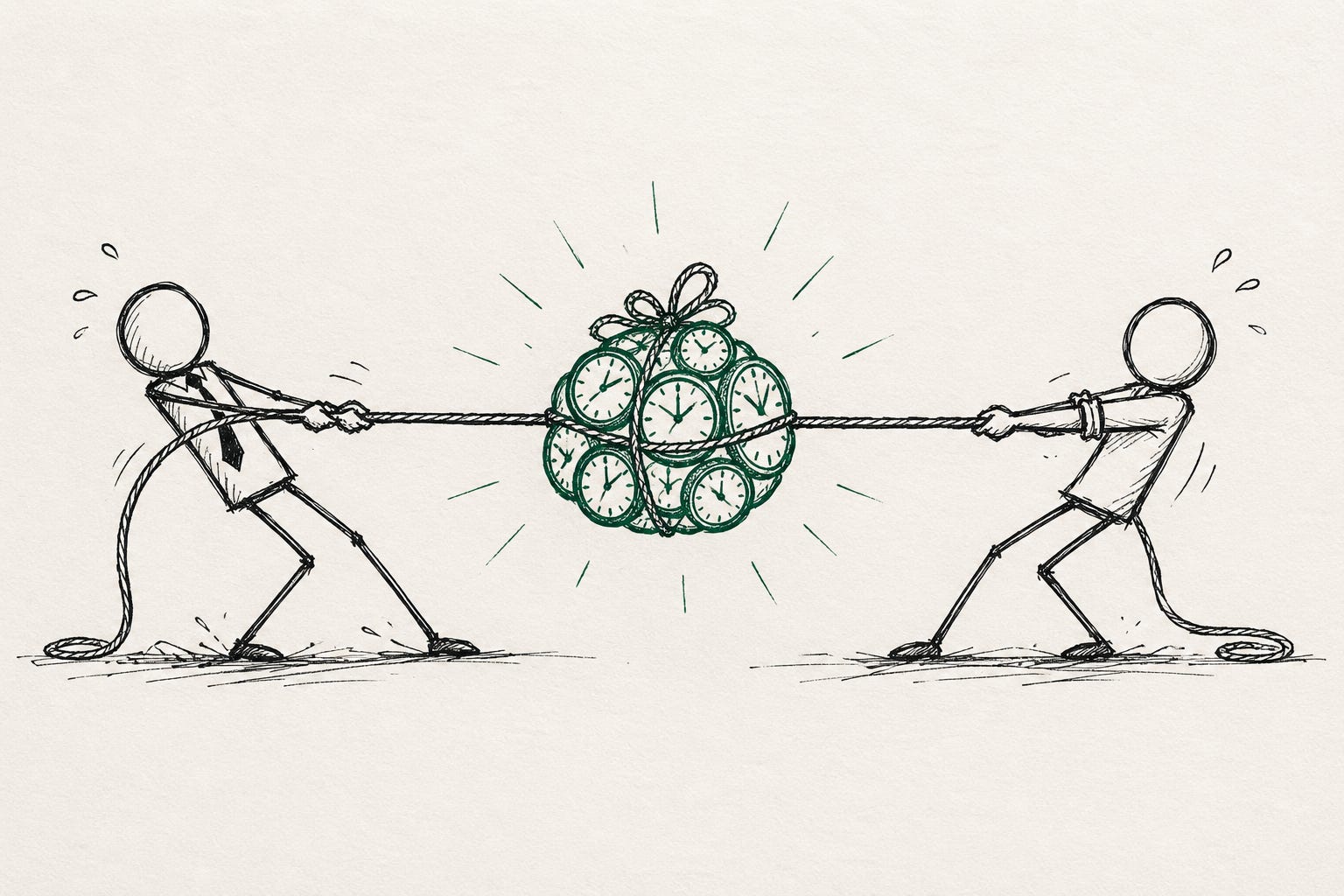
Here's the uncomfortable truth nobody wants to say out loud: AI created a massive productivity surplus. And now there's a fight over who gets to keep it.
The Company's Side (And They're Not Wrong)
Amazon cut 30,000 corporate roles in four months. CEO Andy Jassy said AI would "reshape operations and reduce the need for some corporate roles." Block slashed 40% of its workforce - over 4,000 people. Jack Dorsey's explanation was blunt: "A significantly smaller team, using these tools, can achieve more."
And if you run a company, this math is hard to argue with.
If a team of 10 can now produce what used to take 15, why keep 15? That's not cruelty. That's the same logic every business has followed since the invention of the assembly line. New technology creates surplus. Organizations capture it.
This is what companies do. They're not going to look at a 40% productivity gain and say "great, everyone go home at 2pm." They're going to say "great, we need fewer people" or "great, now this team can take on the project we couldn't afford before."
UC Berkeley researchers tracked about 200 employees at a tech company for eight months. The ones who adopted AI expanded scope, took on tasks they used to outsource, blurred work-life boundaries. But here's the part people miss - the environment drove much of that expansion. When you finish faster, expectations adjust. Not through some official policy. Just... naturally. Deadlines tighten. Scope grows. "You can handle this now, right?"
The organization absorbs the gain. That's not a bug. That's how organizations work.
The Individual's Side (And They're Not Wrong Either)
But if you're the person doing the work, this deal feels terrible.
You learned the tools. You got faster. You upskilled on your own time. And your reward is... the same salary, more work, and the vague threat that if you don't keep accelerating, someone cheaper (or no one at all) will replace you.
ActivTrak analyzed 164,000 workers and found that after AI adoption, focused deep work actually dropped. What went up? Coordination. Messaging. Context-switching. People produced more but spent their "saved" time managing the increased volume.
Upwork found 77% of professionals reporting increased workload despite speed gains. Not because they chose more work. Because the system metabolized their efficiency before they could.
So you're faster, busier, more mentally loaded, and now you're also reading headlines about AI replacing your job entirely. The individual's rational response is obvious: capture the gains yourself. Work less. Automate quietly. Don't advertise how fast you've become. Because the moment you do, the surplus gets claimed.
And honestly? I don't blame anyone for thinking this way.
The Dilemma Nobody's Solving
This is a genuine dilemma. Not a problem with a clean answer.
The company is right that capturing productivity gains is how businesses survive and grow. Every major economic shift - mechanization, computers, the internet - played out this way. The surplus got absorbed into growth, lower costs, or headcount reduction. Expecting AI to be different is naive.
The individual is right that they're the ones who developed the capability, and watching all the benefits flow upward while the workload flows down is demoralizing. Especially when "upskilling" was supposed to be the answer to job security, and now upskilling just means doing three people's jobs.
Neither side is being greedy. Both are being rational. And that's what makes this hard.
What History Tells Us (It's Not Comforting)
Every major productivity technology has created this exact tension. And historically, the organization wins first.
The industrial revolution made workers dramatically more productive. Factory owners captured the surplus for decades - longer hours, lower per-unit wages, child labor - before unions, regulation, and social pressure redistributed some of the gains back to workers. That redistribution took 50-80 years.
Computers made office workers more productive starting in the 1980s. Companies captured it through headcount efficiency. The "productivity paradox" of that era was that GDP rose but wages didn't. It took until the late 1990s for workers to see meaningful wage gains from the computer revolution.
The pattern is consistent: technology creates surplus, organizations capture it first, individuals eventually claw some back through market dynamics, regulation, or cultural shifts. But "eventually" can mean a generation.
So Who Wins With AI?
I think it depends on what kind of work you do.
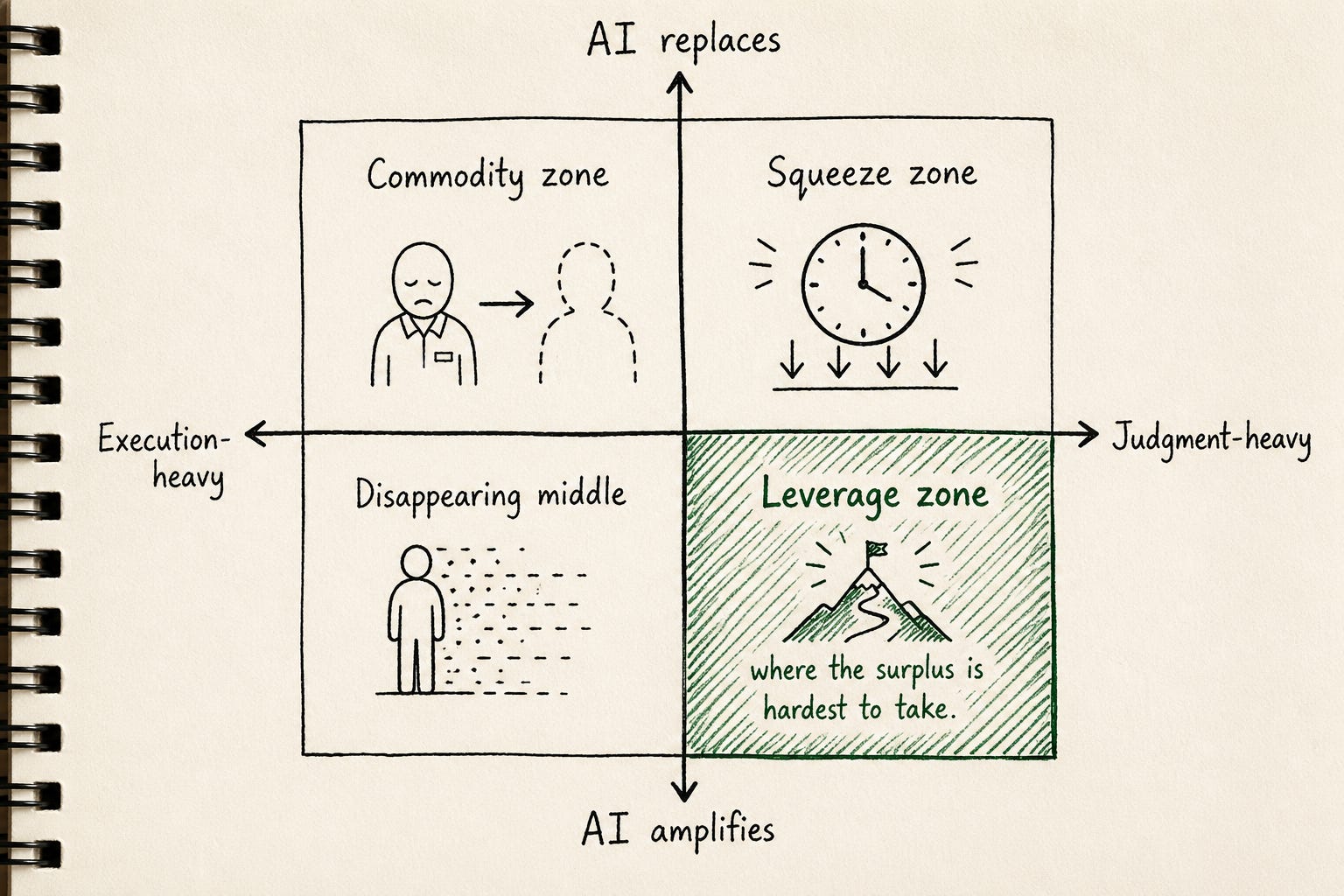
If your job is primarily execution - producing deliverables that AI can now produce faster or cheaper - the organization will capture most of the surplus. This is already happening. The layoffs aren't rumors anymore.
If your job is primarily judgment - deciding what to build, which problems matter, how to navigate ambiguity - you're in a stronger position. AI amplifies your judgment instead of replacing it. And the surplus is harder for the organization to extract because it lives in your head, not in a workflow.
The most interesting case is the middle. People whose jobs are a mix of execution and judgment. They're faster at the execution part, which means they can spend more time on the judgment part. But only if they actively make that shift. If they just do more execution faster, the organization absorbs the gain and they become easier to replace.
What I'm Actually Doing About This
I don't have a grand theory. But I've been thinking about this as both a founder and an individual.
As a founder, I'm trying to resist the default of just piling more work on a faster team. The temptation is real. "We can do more" is the most natural sentence in business. But I've burned out teams before, pre-AI, with exactly this logic. More capacity doesn't mean more should get done. Sometimes it means the same things get done with more care, more thinking, more space.
As an individual, I'm deliberately shifting my time toward work AI can't absorb yet - strategic decisions, relationship-building, the kind of thinking that requires sitting with ambiguity. Not because I'm noble. Because that's where the leverage is. The execution layer is getting commoditized fast.
The honest answer is that this tension won't resolve cleanly. Organizations will squeeze. Individuals will protect. The people who navigate it best won't be the ones who pick a side - they'll be the ones who understand both sides well enough to position themselves where the surplus is hardest to take from them.
That means moving toward judgment. Toward the work that gets more valuable when AI handles the rest.
Not because it's fair. Because it's the game.
Where are you feeling this tension most - your company capturing your AI gains, or you trying to keep them? I'm collecting perspectives for a follow-up. Send me a dm.