


When I ran LifeHack with a team, I sat through a leadership review where someone asked, "what did we actually learn last quarter?" The room went quiet. Not because nobody had worked. Everyone had worked hard. The team had shipped, sold, hired, and put out fires. The silence was because nobody could reconstruct what had actually happened.
That silence is not a culture problem. It is not a discipline problem. It is a system problem.
The company was an open loop. It executed, but it did not learn from itself.
That memory has stayed with me, because the same pattern shows up in every operator conversation I have today. Most companies are like this. Most lives are too. And I think the next five years will sort companies into two piles based on a single property: whether their loops actually close.
What an open loop is, and what a closed loop is
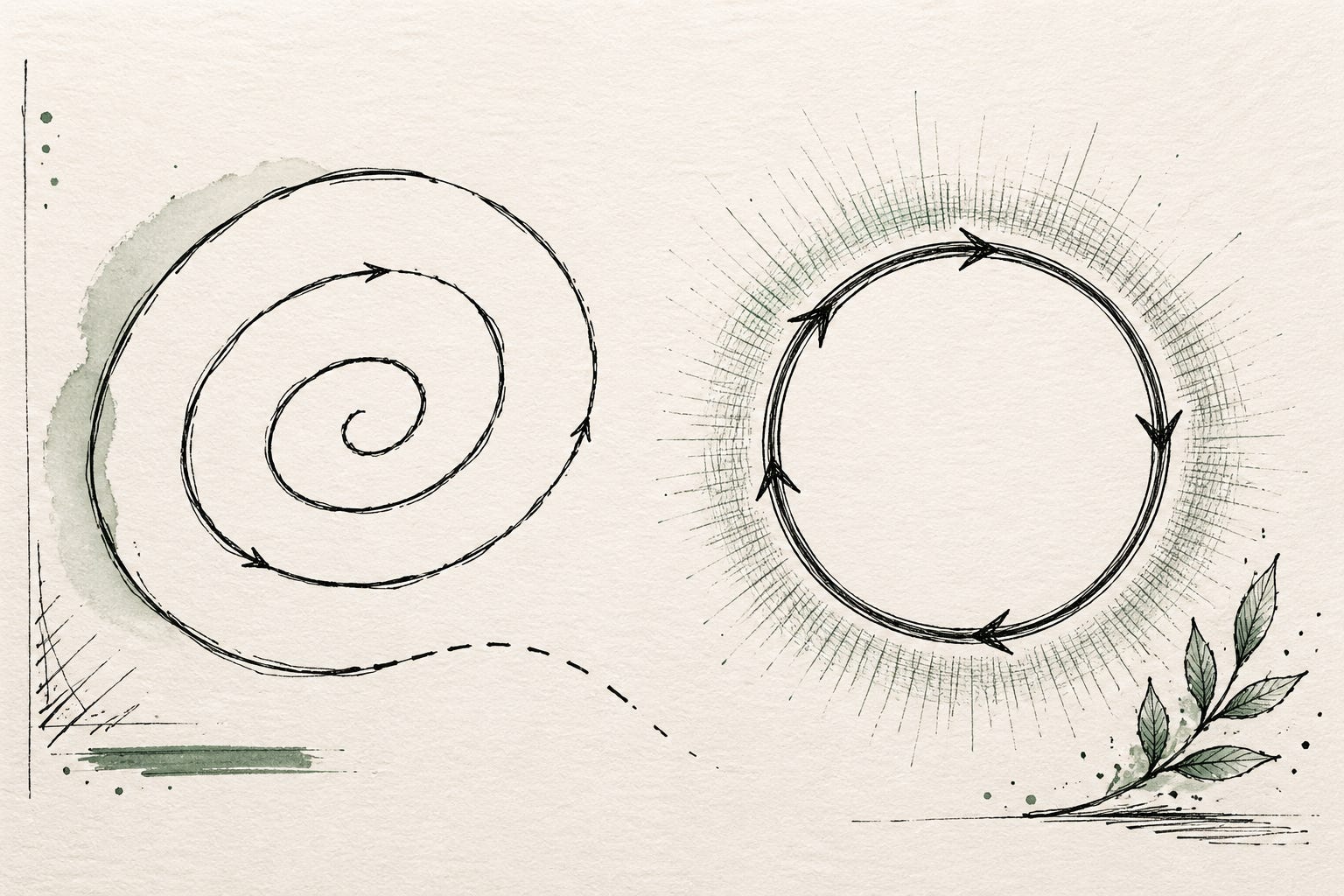
An open loop runs forward and never turns around. You decide. You do. You half-observe what happened. You start the next cycle with most of the lesson already gone.
A closed loop turns around. You capture the input and the reasoning. You execute. You capture what shipped and what slipped. You measure the outcome against the intent. You feed the result back so the next cycle starts smarter than the last one.
Open loops repeat. Closed loops compound.
If you only take one sentence from this post, take this one: if a process matters in your company, it should produce artifacts the company can learn from later. Without those artifacts, the process is open. It does not matter how earnest the retro is.
Why almost every company is an open loop by default
I want to be precise about how the leak happens, because most operators I talk to think their company is closed when it is wide open. I thought the same thing about mine, back when I was running it.
A normal decision in a normal company goes like this. Someone makes a call, often in a DM or a hallway. Work gets assigned, sometimes verbally. People execute. Status gets reported manually, usually in a meeting that nobody records. Outcomes are partially observed by the people closest to them. Lessons get inconsistently captured, often nowhere. The next cycle starts with most of that context gone.
Information loss happens at every step. The reasoning behind a decision dies in Slack. The tradeoffs you considered die in a 1:1. The customer context that shaped the spec dies in a sales call recording nobody re-watched. The reason a sprint slipped dies in three engineers' heads.
By the time the next planning meeting arrives, the company is operating on memory, not data. And human memory is a famously bad database.
This is why so many companies feel busy and slow at the same time. They are not slow because people are lazy. They are slow because every cycle pays a tax to reconstruct context that should have been captured the first time.
A lot of middle management exists to pay that tax on behalf of the rest of the company. People become the integration layer because the system is not one. That is an expensive way to run an org chart.
Five places companies leak the loop
If you are an operator and you want to find your own open loops fast, look here first.
Decisions in DMs. The reasoning behind most important calls in your company is in private channels nobody can search. When the decision turns out to be wrong six months later, the reasoning is gone. You cannot learn from a decision you cannot reread.
Meetings without artifacts. Sales calls, design reviews, hiring debriefs, customer interviews. These happen, then evaporate. The team that did the meeting walks away with a vibe. Everyone else gets nothing.
Roadmaps disconnected from outcomes. What shipped lives in one system. What moved the metric lives in another. Often nobody connects the two on purpose. So the company keeps shipping things and keeps being surprised by which ones mattered.
Customer signal stuck at the edges. Support hears the same complaint forty times. Sales hears the same objection in every demo. Product almost never finds out in a form they can act on.
Retros that do not change next sprint. Lessons get "captured" in a doc nobody opens before the next planning meeting. The lesson exists. It just does not enter the next cycle.
These five are where I would start. If even one of them applies, your company has an expensive open loop running right now.
What it takes to actually close one
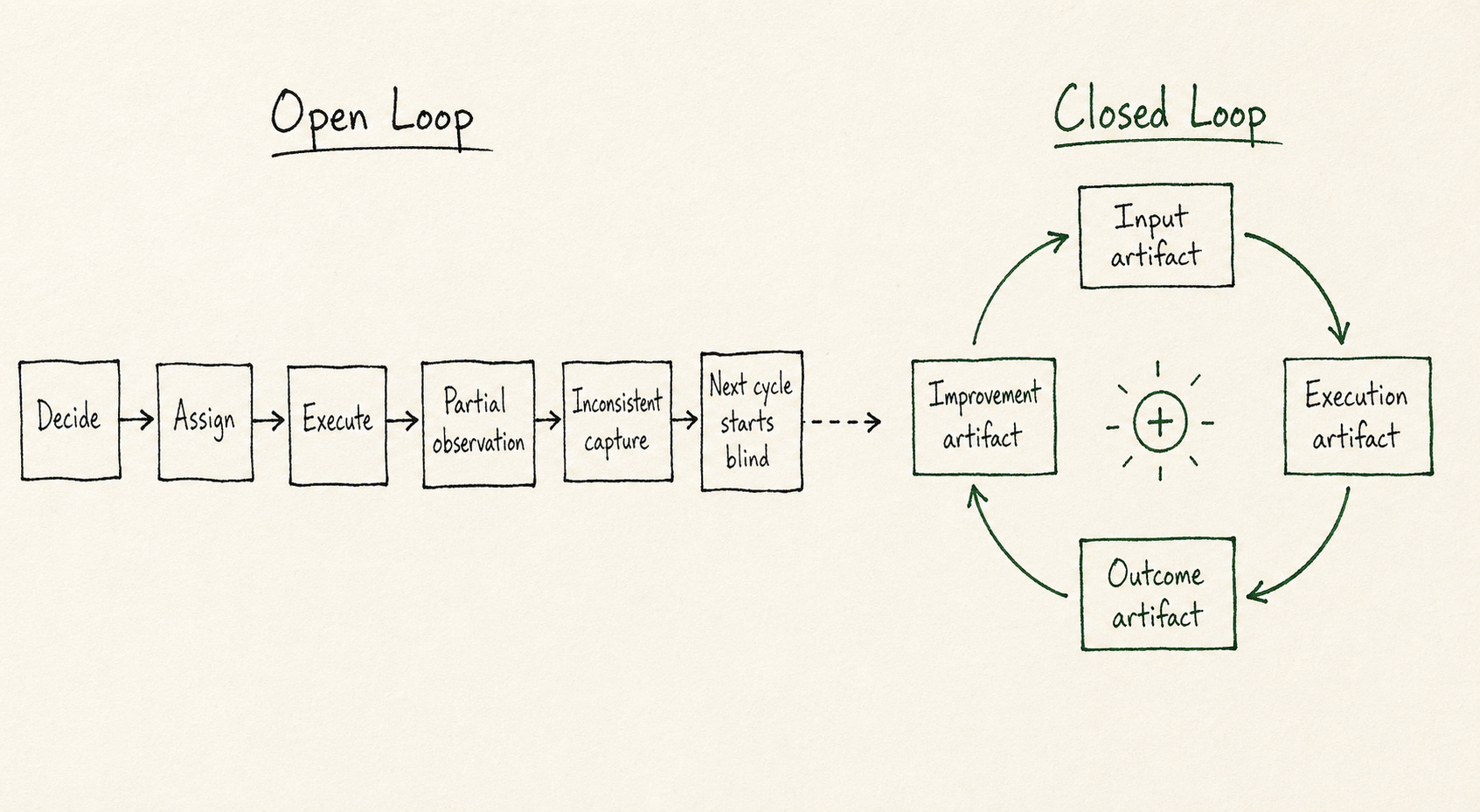
A closed loop produces four artifacts every cycle. Not three. Not "the important ones." All four.
The input artifact: what you decided, with what context and what constraints. Written down somewhere durable.
The execution artifact: what shipped, what slipped, what changed mid-flight, who owned what.
The outcome artifact: what actually happened, measured against the original intent. Not what you hoped happened.
The improvement artifact: what specifically changes in the next cycle because of this one. Not "we should be better at planning." Something concrete you can point at.
If any of the four is missing, the loop is still open. This is where I see most teams stall. They produce two of the four and call it done. A retro doc with no measured outcome is not a closed loop. A dashboard with no decision attached is not a closed loop. A specific change that is not tied to a measured outcome is just a vibe.
The four artifacts are the contract. Tools come second. You can run a closed loop with Notion and a calendar if you actually produce all four.
Why this is suddenly worth doing
Closed loops were always the right design. For most of my career they were just too expensive to run.
Capturing meetings, summarizing calls, reconciling specs against shipped code, tying customer signals to roadmap items, reading last quarter's retros before this quarter's planning. This was a full-time job per loop. Most companies hired a chief of staff to do a fraction of it.
LLMs collapse the cost of synthesis to near zero. Recordings become structured summaries. Tickets and PRs become a queryable history. Customer tickets become trend reports. Old sprints become advice on this sprint's plan.
This is why I think the AI bill is the wrong thing to be optimizing right now. The AI bill is the price of finally running closed loops at company scale. Cutting it to look efficient is like cutting electricity to save on lighting. You are not saving money. You are turning the lights off.
Context is the new management layer. The more an agent knows about your company, the more loops it can close that no human had time to close before.
I wrote earlier about pointing AI at the business cycle instead of at the person (Your AI Integration Is Stuck in 1992). Closing the loop is the second move. The first decides where AI goes. The second decides whether the cycle gets smarter every time it runs.
One closed loop, in detail
I want to show you what this looks like in practice, because the abstraction does not land until you see it run somewhere specific.
Take sprint planning. Probably the most expensive open loop in any product company.
The open loop version is the one you already know. PM guesses scope. Engineering commits. Half ships, sometimes less. A retro maybe happens. Lessons go in a doc. Next sprint starts from a blank page and a hopeful estimate. The reason last sprint missed is in three engineers' heads, and one of them is on vacation.
The closed loop version looks like this. An agent has standing access to Linear, GitHub, the engineering Slack channel, customer support tickets, sales call transcripts, last sprint's plan, and the actual ship log. Before planning, it produces a brief. What was planned versus shipped. Which work slipped, and why. Which shipped items mapped to a real customer pain in support tickets. Who is overloaded. Where ownership is unclear. Which decisions are blocking work nobody is escalating.
The planning meeting starts from that brief, not a blank doc. The PM is no longer guessing. The engineers are no longer reconstructing. The conversation moves immediately to judgment, not status.
After the sprint, the agent measures the brief's predictions against reality. The estimates that were wrong get tagged. The work types that consistently slip get flagged. The next brief is sharper. Two quarters in, planning takes half the time and the plans are closer to what actually ships.
This is one loop. Same mechanic works for customer feedback synthesis, support triage, hiring pipeline review, incident postmortems, sales call analysis, onboarding improvement. Pick the most painful one. Run it through the four artifacts. Watch what happens.
The questions that find your open loops
If you are a founder or an operator and you are trying to figure out where to start, sit with these for ten minutes.
Where does important context disappear in your company? Be specific. Name the channel, the meeting, the system.
Which decisions do you make repeatedly without learning from outcomes? Hiring decisions. Pricing decisions. Roadmap calls. Marketing bets.
Which meetings exist only because your systems are not queryable? Most status meetings are this. Most "let me get the team together to align" meetings are this.
Which roles in your company mostly route information rather than create value? Be honest. This is uncomfortable.
Which processes could close their loop tomorrow if an agent had the right context? Usually more than you think.
If a question landed hard, that is your first loop to close.
Two weeks, one loop
I would not redesign the company. I would not buy a platform. I would run one loop end to end and see if it changes anything.
Week one: pick one process. Sprint planning is a good first one. So is customer feedback to roadmap. Wire up the inputs. Get the recordings, the docs, the tickets, the dashboards into a place an agent can actually read them.
Week two: run the loop. Produce all four artifacts. Compare the agent-assisted version against the way you used to do it. Decide what to keep.
If it works, name a person who owns that loop. Pick the next one. Two loops a quarter is a fast pace at company scale. In a year you have closed eight. Most of your competitors will not have closed one.
The personal payoff
Once you can see open versus closed loops at the company level, you cannot unsee them in your own life. I did not expect this when I started thinking about it for work.
Most personal life systems are open loops too. We make decisions about training, money, sleep, family, career bets, and almost never check the outcome against the assumption we made when we decided. We journal the input. We set the goal. Neither closes the loop.
The same four artifacts work at personal scale. An agent that has access to your calendar, your workouts, your journal, your finances, and your goal file can produce a weekly brief. What moved this week. What decayed. What you said you would do and did not. What specifically to change next week. You read it. You judge it. You adjust.
A 45-year-old running an open-loop life feels busy and gets nowhere because nothing compounds. The years stack up. The lessons do not.
The mechanic is identical to the company version. Only the artifacts change.
What actually compounds
Open loop companies forget. Closed loop companies compound.
Open loop lives forget. Closed loop lives compound.
The companies that pull away over the next five years will not be the ones that "use AI" the most. Everyone uses AI now. The ones that pull away will be the ones whose loops actually close, where every cycle is sharper than the last because the artifacts from the last one are still in the room.
This week, name one open loop in your company. Just one. Close it before you close any others. See what changes.
Then look at your own life and pick one there too.