


It's an exciting time for entrepreneurs and technology enthusiasts. We're in the midst of a new gold rush driven by artificial intelligence (AI), similar to the internet boom. This major infrastructure shift has created countless opportunities, with people and companies investing heavily to build solutions on top of this new AI foundation. Global investments in AI have reached over $150 billion, with major players like Microsoft, Google, and OpenAI leading the charge. Just as the early internet boom enabled new industries and ways of working, this AI infrastructure is driving transformative innovation. In the sections that follow, we'll explore how this shift has unlocked opportunities in the application layer, allowed AI to go beyond simple automation, and enabled AI agents to directly interact with our digital environments. Those who understand and act on these opportunities could lead significant changes in industries and everyday life.
The Application Layer: Where the Real Opportunities Are
AI has three main layers, as described in Sequoia Capital's article 'The Agentic Reasoning Era Begins' (Sequoia, 2024). These layers play distinct but interconnected roles:
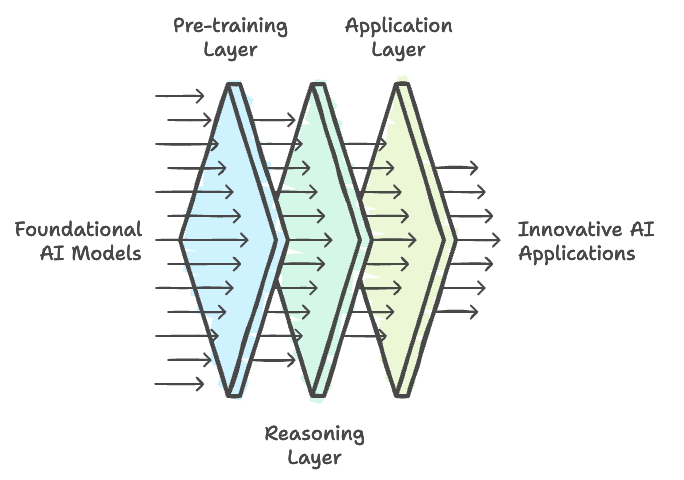
Foundational Infrastructure (Pre-training Layer): This layer includes large language models and pre-trained systems that form the core capabilities of AI. These provide the foundational knowledge that AI needs to function effectively.
Reasoning or Inference Layer: In this layer, models are equipped to think deeply and reason through problems, similar to AlphaGo's advances in 'System 2' thinking. This layer allows AI to go beyond basic outputs and perform more complex, context-aware tasks. From my experience, fine-tuning models in this layer can still result in inconsistencies, as the AI attempts to simulate human-like problem-solving.
Application Layer: This is where the biggest opportunities lie—creating products and solutions that use AI to solve real problems. Developers can make the largest impact here. By building applications on top of standardized AI models, we can focus on solving user-specific issues, enabling true innovation. Just like upgrading a power grid, these foundational and reasoning models are crucial, yet swappable as technology advances.
Some people may wonder, 'Wouldn't tools like ChatGPT eventually solve every problem on Earth?' The reality is more nuanced. General-purpose tools like ChatGPT can only provide general solutions, struggling with highly specific or niche problems because they lack specialized context. Solving such problems requires more than intelligence—it needs domain-specific knowledge, tailored user interfaces, and specific outputs. Developers can make a major impact by building applications that address these specialized requirements.
Beyond Automation: Replacing Responsibilities
To be truly successful, AI tools must evolve beyond simply assisting humans with minor tasks. Most AI applications today function as co-pilots, supporting while humans remain in control—managing decisions and giving instructions. This is helpful but limited. Real change requires aiming higher.
In my experience developing AI applications, I've noticed that current systems can still be inconsistent, even with identical prompts and similar inputs. To overcome these limitations, AI should evolve into agents capable of taking full responsibility for complex tasks and completing entire projects autonomously. The ultimate scarcity for humans is not time, but attention. If AI merely functions as a co-pilot, human involvement becomes a bottleneck, making it unscalable.
True AI agents aren't just about reducing clicks or automating simple tasks; they must execute entire workflows independently. There are four levels of AI agents:
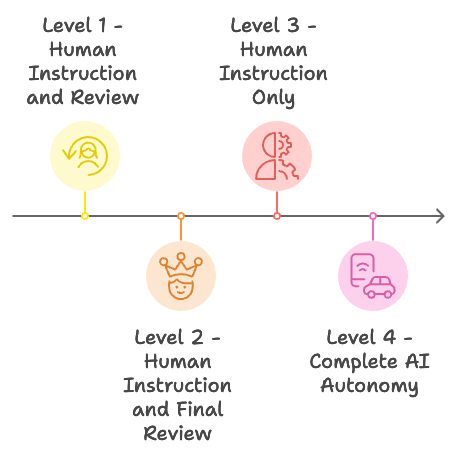
Level 1: AI agents do the work, but humans must give instructions, review during the process, and review the final work.
Level 2: AI agents do the work, but humans must give instructions and review the final work.
Level 3: AI agents do the work, but humans must give instructions only.
Level 4: AI agents do the work entirely without human input.
Each level represents a progression toward reducing human involvement, with the ultimate goal being full autonomy. However, no true Level 4 agents exist yet. Achieving this level will require significant improvements in model consistency, testing, and evaluation to ensure reliable outcomes without human intervention.
AI Agents to Do Every Computer-Based Job
A significant leap forward in the AI landscape is the development of models that can directly manipulate desktop environments and computer systems, such as Claude 3.5's Sonnet model. This model has the capability to use tools to interact with a desktop environment autonomously, repeating actions without user input. This type of behavior is known as an "agent loop," which allows Claude to perform tasks such as managing files, editing documents, or running software by following logical sequences of steps.
For instance, the upgraded Claude 3.5 can interact with predefined tools like a computer environment, a text editor, and a Bash terminal. This allows it to not only analyze data but also modify system environments directly, taking on even more responsibility. Imagine a situation where an AI agent can run software tests, update spreadsheets, or execute scripts as part of its normal workflow—all without human intervention. This extends the usefulness of AI from providing information or insights to acting as an operational assistant, capable of doing real, practical work on the computer.
By focusing on these tools, AI could do almost any computer-based job. Combining reasoning capabilities with direct interaction, AI applications like this can evolve into true agents, automating entire segments of workflows. They aren't just reducing clicks or filling forms anymore—they’re executing end-to-end processes that involve multiple tools and steps. Such capabilities represent a major transformation in how we work, allowing businesses to leverage AI as not only a supportive tool but also as an autonomous worker that directly operates within our digital environments.
Trusted Experts in Every Field
Imagine AI not just as a helper that fills in the blanks, but as a trusted expert that can do important parts of a job. This lets people focus on bigger-picture tasks like planning, creating, and building relationships. These AIs aren't just helping; they are actually doing significant parts of the job, allowing people to focus on tasks that require a human touch, such as creativity and strategy. This change helps reduce repetitive work, alleviate burnout, and enable people to engage in more meaningful activities. For businesses, this means greater efficiency, more innovation, and the ability to adapt more quickly.
This is where the real opportunity lies. AI apps that can understand and replicate key parts of human roles—making decisions, providing insights, and exercising good judgment—are the ones that will succeed. The current AI gold rush isn’t just about making things faster; it’s about creating meaningful tools that transform industries and the way we work.