


A team of people used to run LifeHack. Today the company runs on agents, and I'm the only human left in the loop.
The fleet is 129 agents at last count. They write, research, measure, render video, draft support replies, watch markets. Most of them came out of rebuilding LifeHack into an AI-first operation; the same patterns now run my consulting pipeline and my trading watchlists too. I never designed a taxonomy for any of it. But this week I audited the whole fleet, and every agent had settled into one of five shapes. Not roughly five. Five, with no stragglers: the ones that didn't fit cleanly turned out to be misbuilt, and each was drifting toward one of the shapes anyway.
That's worth more than a tidy diagram. It means agent architecture isn't a blank canvas where every pipeline is a fresh design decision. A few properties of the work generate the structure, the same way load and span generate a bridge. Once you can read those properties, the next agent designs itself. And if you're rebuilding a human-run company into an agent-run one, as I did, the five shapes are the whole org chart.
The Three Questions
Three questions about the work decide which shape an agent takes.
Does it change anything outside my system? An agent that only reads, measures, or writes internal files can be wrong cheaply. An agent that posts, sends, or schedules cannot. This question decides whether the structure needs an approval gate, a point where the loop stops and waits for a named person, and where that gate goes: directly in front of the action you can't take back.
Does the draft keep overnight? A reply to a live conversation is stale in hours. A rendered video is exactly as good next Tuesday. Perishable work fuses creation and publishing into one run. Storable work lets you split them, and the split is where most of the interesting structure lives.
How many commitments are in the work? Posting a reply is one commitment. Shipping a blog post is two: putting a draft up for review under my name, then making it public. Each commitment is a separate decision, and separate decisions want separate stops.
Ask those three questions of any job you're handing to an agent, and one of five shapes falls out.
Shape 1: The Worker
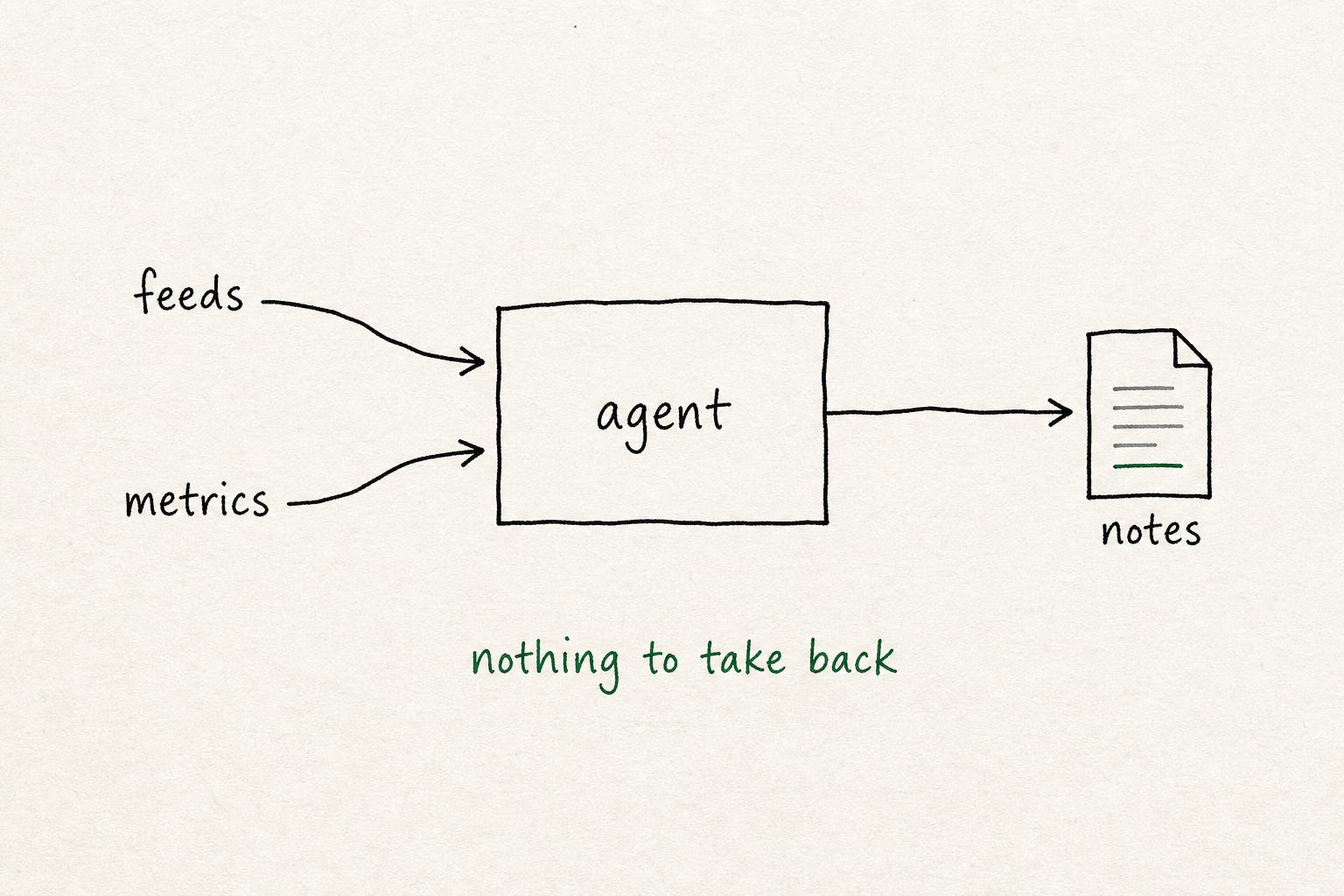
Reads, researches, measures, summarizes, writes internal state. No outside mutation, so no gate, no store, no manager. A scout that flags conversations worth joining. A measurement agent that pulls last week's rankings. If one does its job badly, I delete a file. In a human org, this is the analyst: the research that's on your desk each morning, no signature required.
This is most of my fleet. Of my 129 agents, 106 never stop for a human, and the bulk of those are workers. That ratio is the point. Workers with no ceremony around them are what keep the ceremony meaningful everywhere else. If every agent stopped for me, approving would turn into a habit, and habit is where judgment goes to die.
Shape 2: The Correspondent
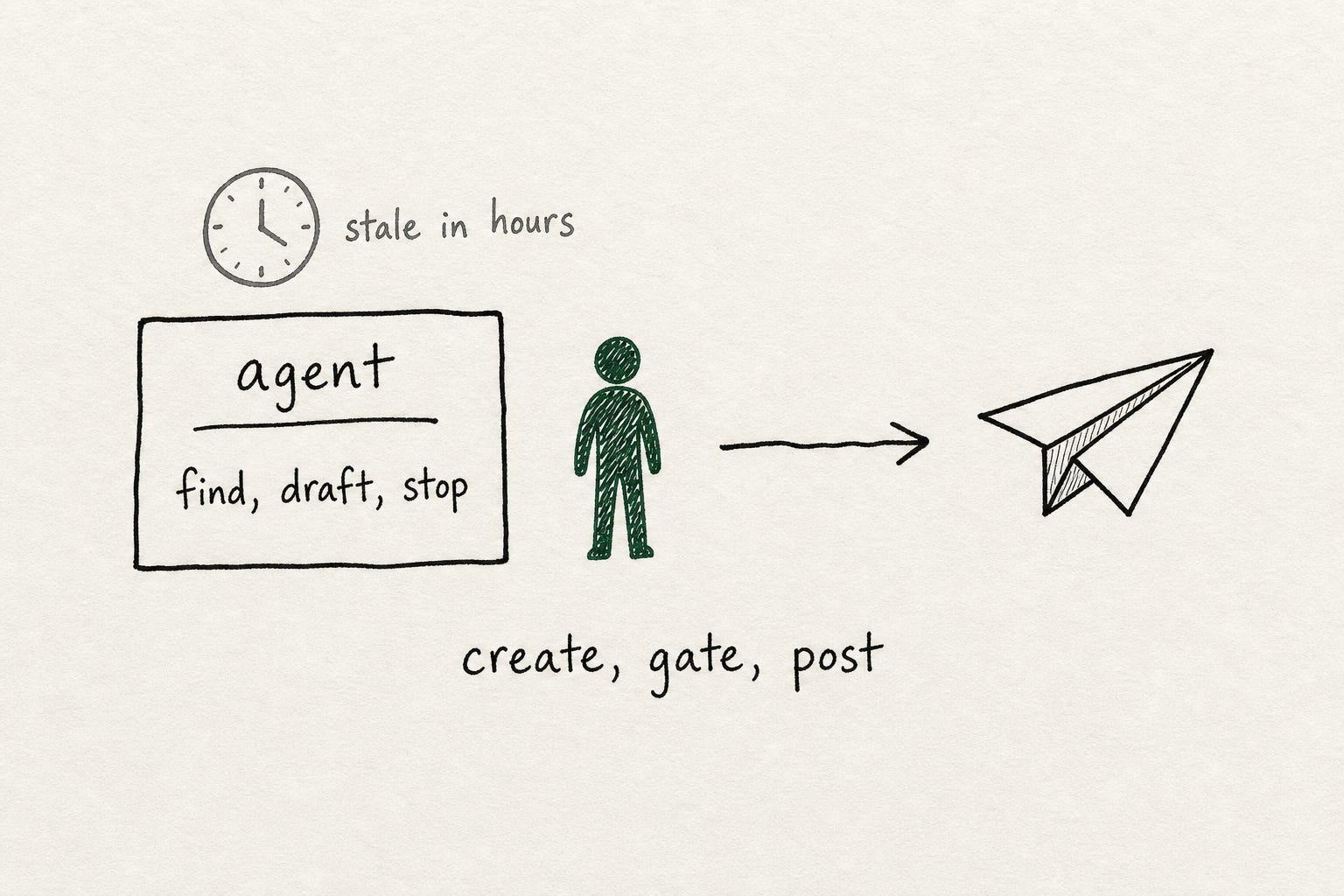
One agent creates one perishable thing and publishes it in the same run. Drafting and posting can't be separated, because the draft dies overnight. So the whole structure is a single file: find the target, write the draft, stop at the gate, post on approval. My reply agents and news-reaction agents are all this shape.
In a human org, this is the correspondent: finds the story, files it, and it runs today with an editor's sign-off, because by tomorrow it isn't a story. The gate is inline, one line before the irreversible send. There's nowhere else it could go.
Shape 3: The Dispatcher
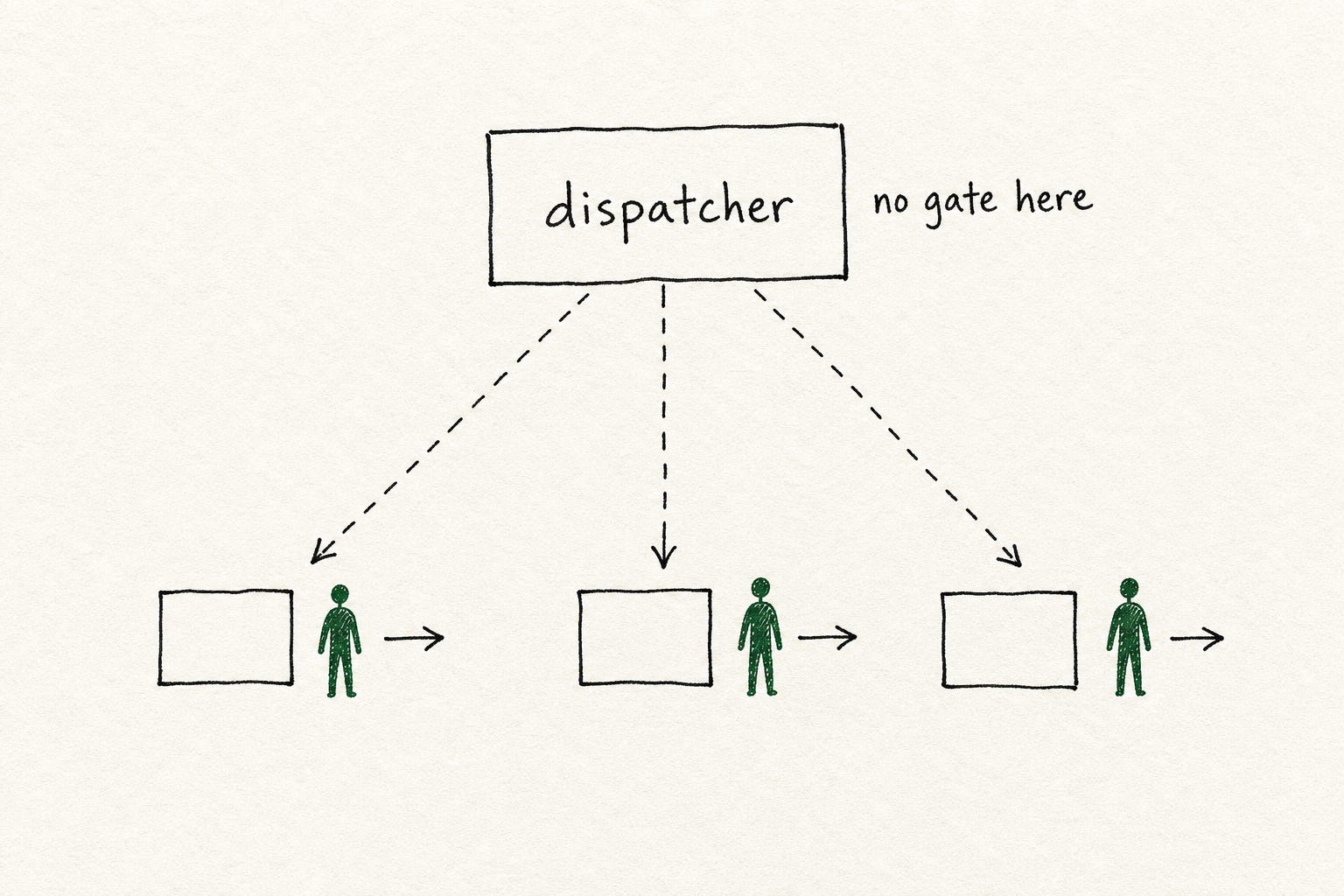
A manager that owns strategy and cadence, decides which agent runs today, and delegates. It looks senior, but notice what it never does: touch the outside world. Routing is reversible. Delegating is reversible. So the dispatcher itself carries no gate; every agent it dispatches keeps its own.
In a human org, this is the chief of staff: decides what gets done this week, and does none of it personally. The shape exists to hold the judgment that doesn't belong in any single agent below it: how often to engage, which mix of activities, when to stand down.
Shape 4: The Inventory Pipeline
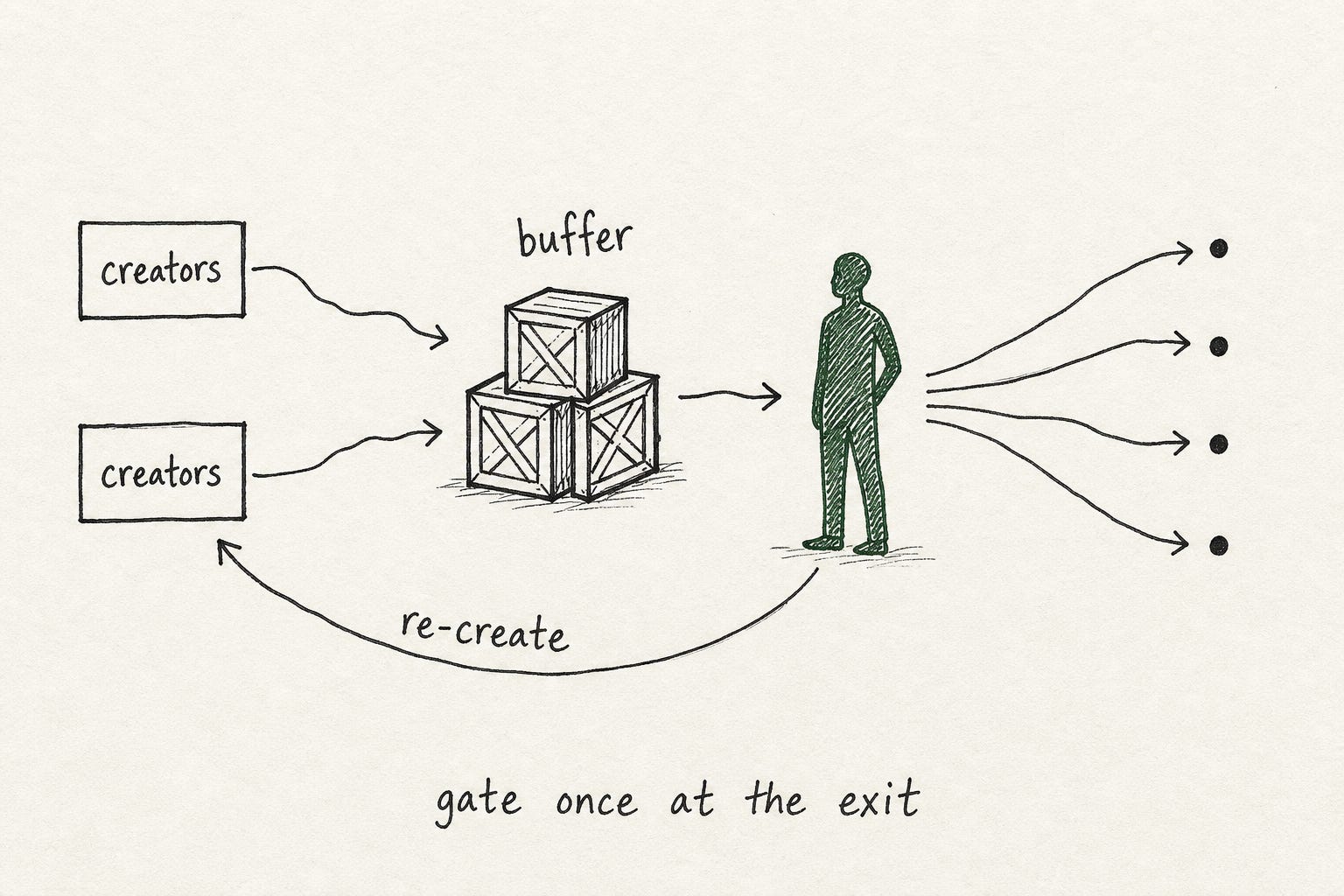
When the artifact keeps, you can split creation from publishing, and the structure grows a warehouse in the middle.
LifeHack's short-video pipeline is the full version. Creator agents run on a schedule with no human anywhere: write the script, render the video with voiceover and captions, verify their own output (aspect ratio, duration, audio present), and file the result in a store. A manager runs separately and makes one decision per run: buffer below five, create more; stock ready and the calendar thin, publish one. Only the publish path stops for me, one gate at the exit, and what I approve there is whole: this video, this copy per platform, this slot across four channels.
The store is what earns the extra moving parts, in one specific place: rejection. When I reject a video at the gate with "the text is cropped on slide three," the manager doesn't shrug and end. It re-delegates to the creator in a re-create mode: same message, same audience, new render fixing the defect, and the new video comes back through the same gate. My rejection became an instruction instead of an ending.
One unglamorous component makes it safe: state. An item mid-approval is marked, so an overlapping scheduled run sees the mark and stands down instead of double-publishing. Boring, structural, and the difference between a pipeline and a race condition.
In a human org, this is the production studio: a small team builds ahead of schedule, and one editor at the exit decides what airs.
Shape 5: The Staged Pipeline
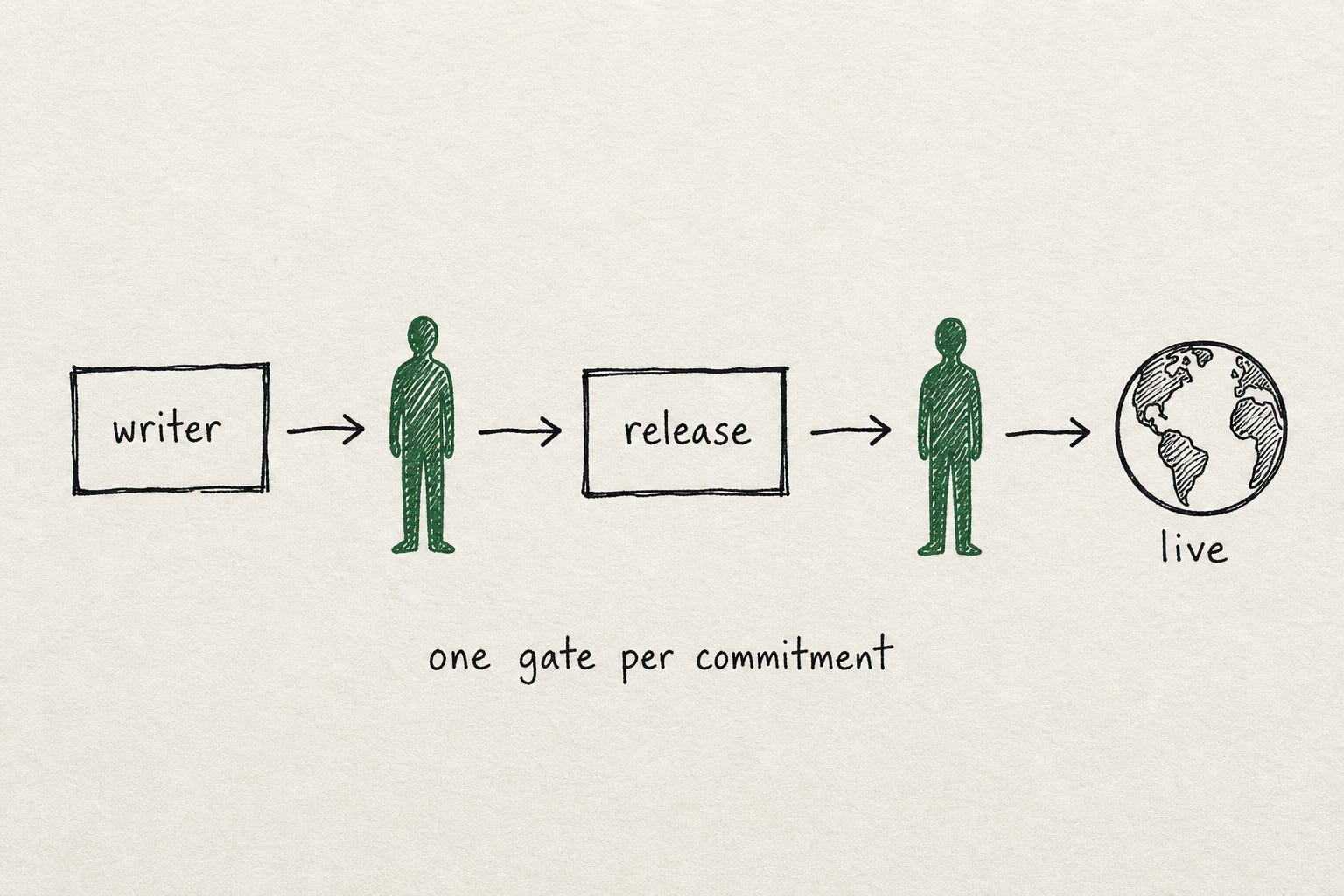
Some work has more than one commitment in it, and each commitment ends a stage. LifeHack's blog pipeline commits twice: a writer agent stops for approval on the draft, a release agent stops again before the post goes live. The LifeHack newsletter, the loop a team once produced by hand, runs the same way, and I've torn that one down in full before: pick the angle at the first stop, approve the rendered send at the second.
The shape looks like several agents chained together, but the chain isn't decoration. Approving a draft and approving a release are different decisions made at different times with different information. Collapsing them into one stop means one of them is being made blind. An exec would recognize this instantly: it's the two-signature process, and the second signature exists for the same reason it does on a wire transfer.
Reading Your Own Fleet
The taxonomy pays off in two directions.
Forward, it's a design shortcut. Before building anything, ask the three questions. Nothing mutates: worker, and skip the ceremony. Mutates and perishable: correspondent, gate inline. Mutates and storable: inventory pipeline, gate at the exit. Multiple commitments: staged, one gate per stage. Strategy with no mutation of its own: dispatcher. The structure is decided before the first line is written.
Backward, it's a diagnostic. Every agent of mine that felt wrong in practice turned out to be wearing the wrong shape. A correspondent quietly doing strategy that belonged in a dispatcher. A creator with a gate bolted on that gated nothing irreversible, training me to click approve without reading. The fix each time was boring: move the work to the shape the three questions had been pointing at all along.
The good news, if you want to run this way: none of the shapes needs custom infrastructure. I'm building AgentUse, open-source infrastructure for autonomous agents, and every shape in this piece is a few lines of configuration in it. A worker is a markdown agent file with a schedule. A correspondent adds an approval gate. A dispatcher declares its subagents. An inventory pipeline adds a shared store. The newsletter's two stops live in one file. That's the entire stack behind the 129. And when a team wants this built for them rather than by them, that's AgentUse Studio.
If you run agents, classify your fleet this week. One line per agent: which shape, and which question put it there. Any agent you can't place is the one to look at first.
Five shapes. Three questions. The rest is components.